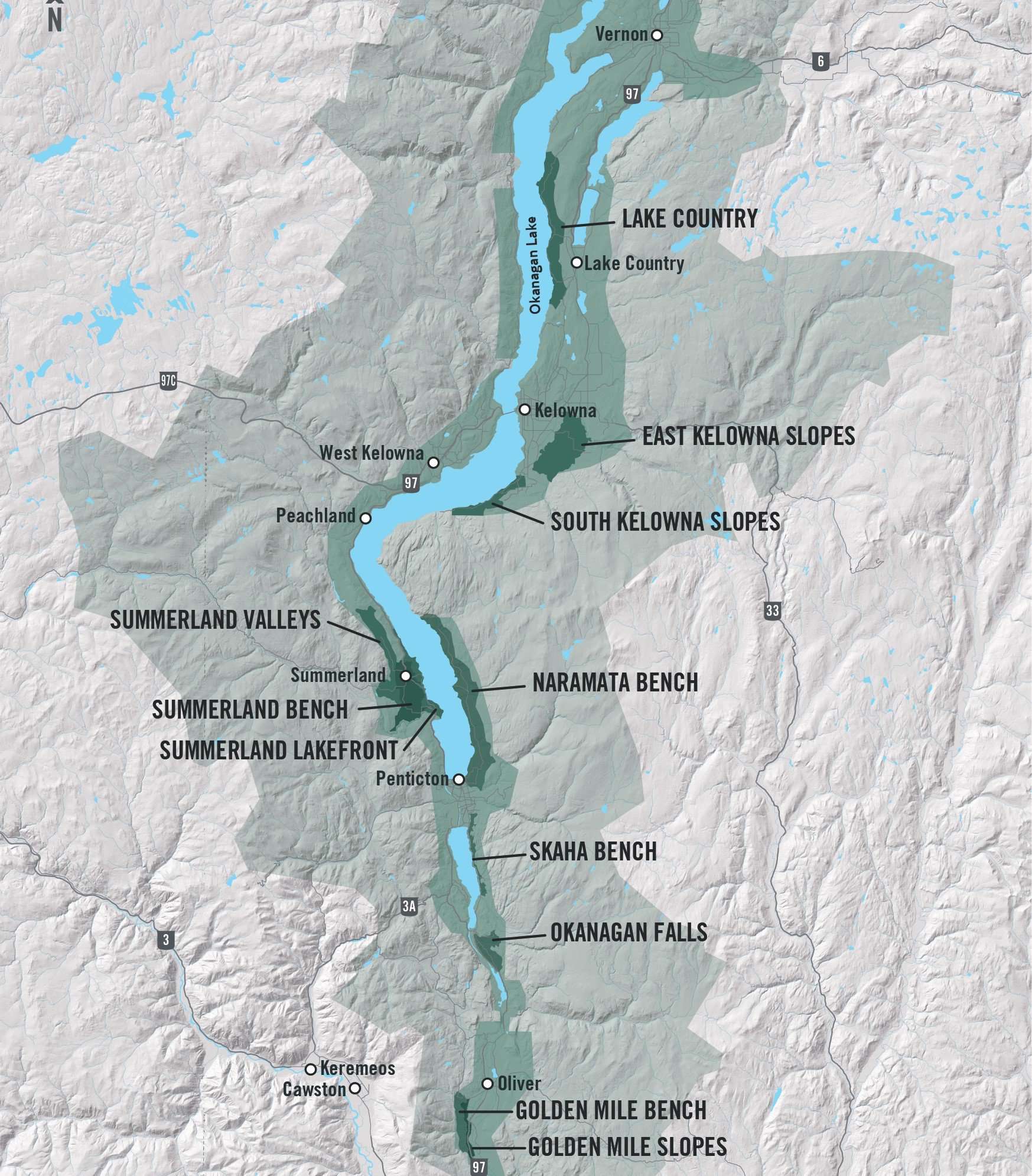
Map of the Okanagan Valley provided by WineBC.com
Nicole MacKay: For people who are pretty new to 1 Mill Road, how would you describe what you’re trying to express with the wines?
Ben Bryan: I think for us, the most important thing with 1 Mill Road is we’re being very variety distinctive, so it is about Chardonnay and Pinot Noir. It is about single sites, predominantly. So, really trying to bring to life the tapestry of viticultural sites that are anchored in both those varieties, from basically Okanagan Falls and northward. We’re heavily anchored in Naramata; it’s probably our favourite place. But it doesn’t restrict us from being, let’s say, East Kelowna or Summerland or even Lake Country, for that matter.
NM: You’re still a pretty small, boutique-sized operation. How does that size shape the decisions you make in the vineyard or the cellar?
BB: I think it’s twofold. One is there is the daunting nature of being small; if you make a mistake, you don’t get to just blend it away. But on the flip side, any decision that is made is deliberate. It’s based on experience, perspective, and philosophy. You’re making decisions to suit the growing season, the site, and the variety that you’re working with. We don’t get everything 100% right, but that’s when the skill of winemaking comes in; we would rather nurture, but sometimes a decision doesn’t go where you feel it should.
NM: Looking at the newest releases, starting with the Pinot Noir, what can you tell me about your journey with this wine?
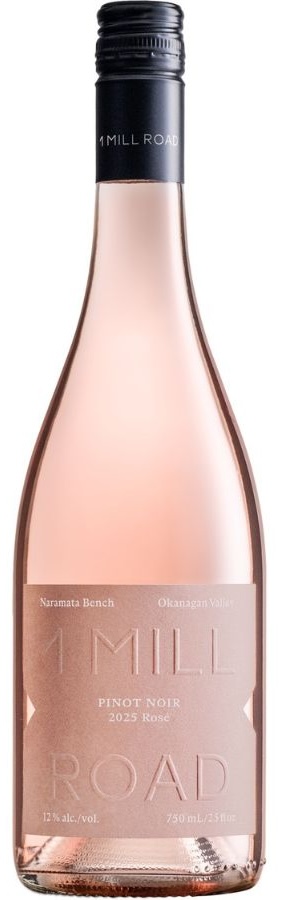
BB: The interesting thing from a rosé perspective is our first two releases were from East Kelowna. Then from the deep freeze, we had to go south and chose Grenache, again from a single site. Now with this release, vintage ’25 was very fruitful; we were also bringing vineyards online that we were leasing and farming that we didn’t get to work with through the cold, and here they are. From a biased perspective, I’d say it’s probably one of the nicest rosés we have made; from two sites on the Naramata Bench, two clones.
Last year was a warm to hot growing season, but when we needed it to be moderated through the veraison and into harvest, we had beautiful weather, so we were able to retain natural acidity. The most intriguing thing for me is the alcohol level, I picked really early. It’s just under 12% ABV, labelled as 12%. But to get the flavour, the texture, and the absolute balance at that alcohol is probably the most rewarding part. Working through the wine I was like, it’s not going to work — and here we are, and I think it’s worked beautifully.
NM: Was the intention for a rosé all along? And are there any decisions you’re making along the way to determine how you’re going to identify it as a rosé versus a varietal red?
BB: Yes, where I’ve got a site, I tend to grow Pinot all the same, but there may be certain areas in a site that maybe slightly more vigorous that I would probably pick as rosé instead of dry red. That’s the biggest perspective — vigour through the vineyard — and a lot of that is influenced not by how you farm, but by subsoil conditions. There might be access to water that’s a little more readily available, and hence you get less restrictive conditions on the vine. In terms of vinifying, I tend to be relatively consistent with rosé, implementing relatively cool, slow fermentation. The biggest difference in identification is what percentage is going to go to seasoned barrel through fermentation, and then when I add sulphur and how often I’m doing lees stirring. Other than that, there’s no added acid, no fining; it just comes down to how do I bring it together at the point when I need it to go to bottle.
NM: Shifting to the freezes of the last couple of years — which obviously puts a lot of pressure on small and big producers alike. How did that shape your approach to 1 Mill Road?
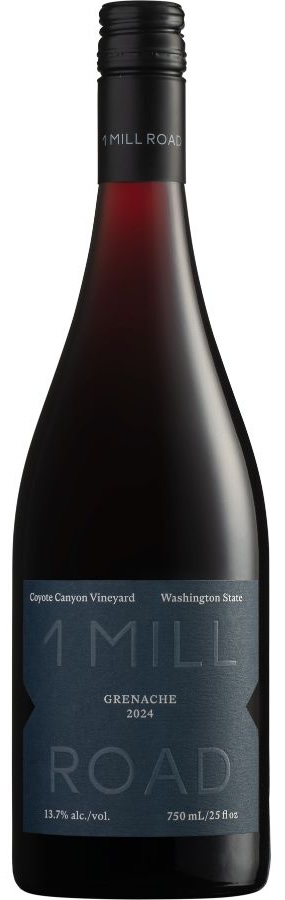
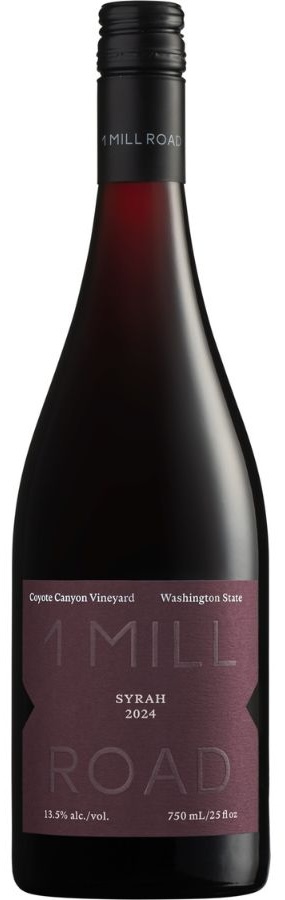
BB: From a winemaking perspective, it meant we could go and work in another region. By default, not design. We needed to create wines and continue to have wine to sell. From a cash flow perspective, you need cash to fund your next vintage. The biggest decision we made through the process was that we didn’t do Chardonnay or Pinot Noir from elsewhere. We could have easily gone to Oregon or anywhere else and got plenty of Chardonnay and Pinot Noir, but we were very deliberate and chose not to, because for us, the Okanagan Valley is where we’re expressing those varieties. We didn’t want to blur those lines. So the decision to do Grenache and Syrah was very purposeful. It was then about finding a like-minded family with a growing philosophy similar to ours, and we were very fortunate to do that with the Andrews family from Kirk Canyon in the Horse Heaven Hills AVA.
NM: That leads to how you ended up in Horse Heaven Hills — how did that search happen? How did you know where to look?
BB: We moved pretty quickly. Through industry contacts, and knowing some of the changes happening in the broader Washington State, it was a call to a previous colleague that put me in contact with one of the best roles available. The Andrews family came back straight away — this is the family you need to work with. We were down there within a matter of weeks, looking at their vineyards and identifying blocks.
NM: What were you looking for in those blocks? How do you go from Chardonnay and Pinot in the Okanagan to knowing what to look for in Grenache and Syrah in Horse Heaven Hills?
BB: Fortunately, coming from Australia, Grenache and Syrah was what we did a lot of, so that was a really nice perspective to draw on. The other great thing is the Andrews family also have their own brands, so we were able to try, in the moment, their own wines from those blocks. Stylistically, we could see where they were going, not that we went in that direction, but we could see the concentration, the purity of fruit. It wasn’t a question of whether this site would make a nice wine; it was just choosing where we wanted it to come from across their property, and then aligning on growing technique, philosophy, and shared vision.
NM: So, the Syrah/Pinot Noir is sold out — were you anticipating that so quickly?
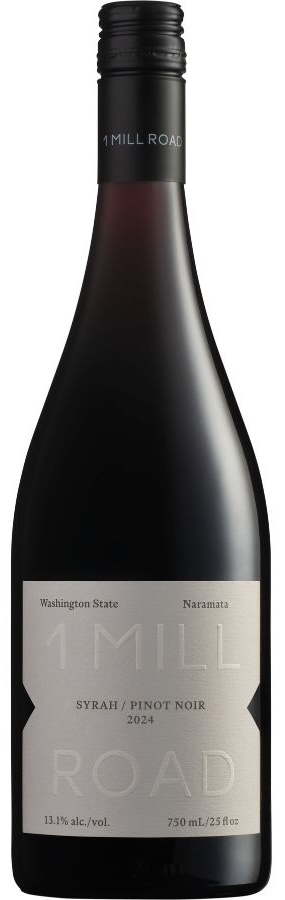
BB: The Syrah/Pinot Noir is an interesting one. It’s a co-ferment and blend of Naramata Bench Pinot Noir, 50% whole cluster and then optically sorted, blended with [Washington State] Syrah at a 50/50 ratio, fermented together at the winery in Naramata. We made about 80 or 90 cases. We used to make a lot of [this blend] in Australia; in the Hunter Valley it was very common, and certainly in Tasmania today, Syrah blended with varieties like this is quite common wherever there’s some altitude. But for me, it was more around this being a defining blend for the vintage, where we basically had nothing from BC and everyone was going south. It was taking a blend I was familiar with but using two countries — and I think it also aligns to our broader perspective: 1 Mill Road is not defined by borders.
NM: That’s something that’s honestly a silver lining with all of the political tension that’s been happening — there really is a cohesiveness with supporting growers south of the border that is somewhat of an untold story.
BB: I agree completely. To me, the replacement wines are about positioning. There was a reason and a purpose for them. I wish we had positioned them even stronger. At the end of the day, all of the replacement wines are being made by winemakers in BC, just grown by farmers south of the border. There was amazing richness and opportunity in that story beyond what became of it. We’re all working with amazing fruit from properties that in many cases are much older than what we get to work with here, just by the age of the industry. There are aspects of that story we could have told much better, with more depth and richness — really unlocking that it’s more than just a replacement, because for 1 Mill Road, it’s more than just a replacement.
NM: What does the future hold in terms of this cross-border partnership? Do you foresee continuing on?
BB: From a brand perspective, it’s always been part of the vision that we would have a Chardonnay and Pinot chapter in BC, and Grenache and Syrah was also a piece of the bigger thinking. We were obviously able to take advantage of the situation under unforeseen circumstances. At this point, we won’t continue, but it’s very likely we’ll bring it back to life once the internal perception of what “replacement” means disappears and the geopolitical tension settles.
NM: You’ve mentioned Vancouver Island as a possibility. Is there a clear path in the next couple of years for expansion, bigger production, or new sites in BC?
BB: There is a vision for expansion, but we want to do it in a very calculated and sustainable way that doesn’t jeopardize the commercials of the business. There are lots of lovely vineyards we could tap into within the Okanagan Valley and certainly further north than Naramata, and we’ll do that thoughtfully. We’re definitely looking at options on the island — we haven’t found what we’re truly looking for yet, but it won’t happen for vintage ’26. Potentially ’27 or ’28, we’ll definitely look to add Chardonnay, if not Pinot as well.
NM: Since you started, what’s been the biggest lesson you’ve learned and had to adapt to?
BB: I think the biggest lesson is dealing with the impacts of the weather events, such as a half crop from ’23 and then no crop from ’24. From a business foundation perspective, that’s been the most challenging to navigate on every level. Fortunately, we’ve come out the other side in a great position. We wish we had more wines to sell, and it’s probably slowed our growth trajectory, but we’re sound, we’re solid, and we have a good plan ahead of us. Vintage ’25 was a great quality and volume vintage, given that the vines basically had two years of doing nothing; they had lots of energy to give. I think it’s more about resilience in mindset and making some smart yet tough decisions in the moment.
The biggest takeaway is really about protecting what’s in the ground, from rootstock to clonal material, and making sure that if we’ve got the vines covered in winter, we reduce the risk of total damage. That way it takes a year to get back, not potentially three to four.
1 Mill Road Wines Related to This Conversation